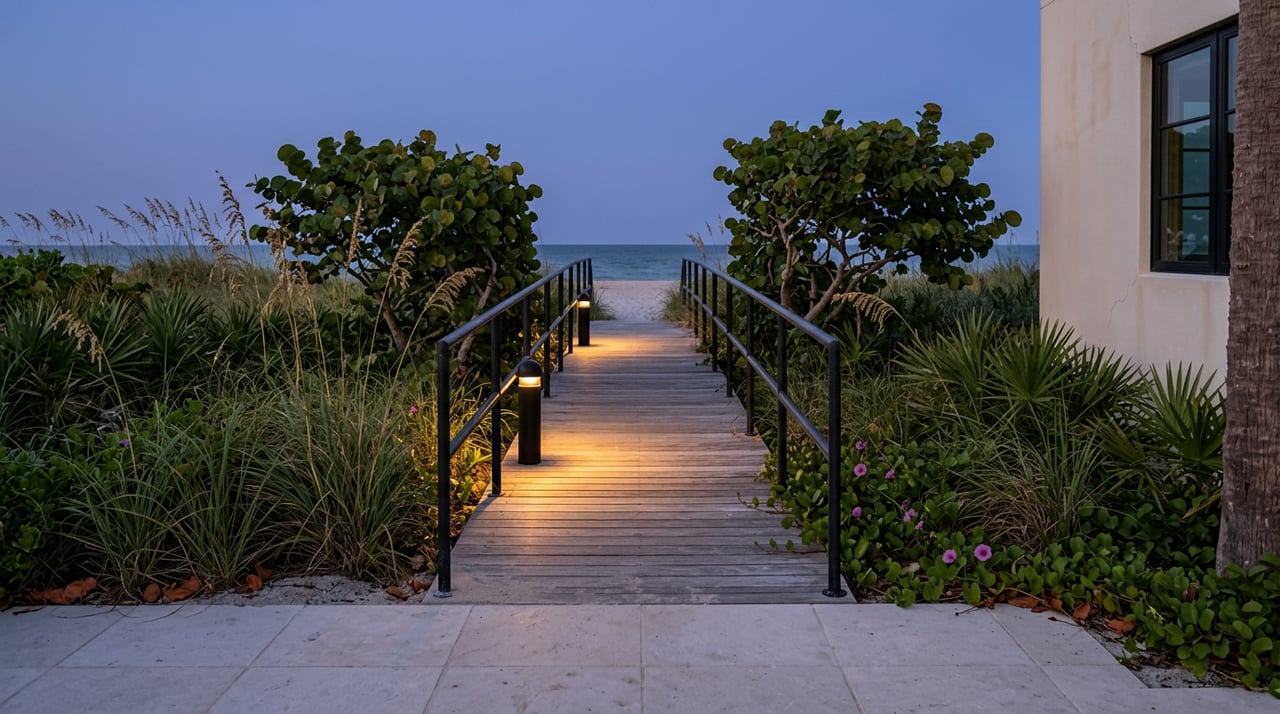
August in Juno Beach During Sea Turtle Hatching Season
August 6, 2026
August 6, 2026
In March, the beach in front of your house was working the night shift. Leatherbacks the size of coffee tables were hauling out under cover of dark, digging, laying, and disappearing back into the Atlantic before sunrise. August flips the script. The eggs those turtles buried in front of your seawall are hatching now, and for the next four weeks the sand between Marcinski Road and the north end of Loggerhead Park is arguably the busiest sea turtle nursery in the country.
That is the part most guides get wrong. They treat sea turtle season as one long thing that runs March through October. For a Juno Beach resident, it is really two seasons stacked back to back, and August is the seam where one ends and the other begins.
The public programs at Loggerhead Marinelife Center, the nonprofit sea turtle research, rehabilitation, education, and conservation facility on the Atlantic in Juno Beach, pivot almost overnight. Guided Turtle Walks, the June and July program built around watching an adult female come ashore, close. In their place, two programs open the same day.
| Program | Starts | Time | Ages | Cost |
|---|---|---|---|---|
| Hatchling Release | August 1 | 8:00–9:30 p.m. daily | 10+ | $40 |
| Hatchling Discovery / Morning Nest Excavation | August 1 | Mornings, Sat/Sun into September | 10+ | Ticketed |
| Guided Turtle Walks | Ended July 31 | — | — | — |
Hatchling Releases and Morning Nest Excavations start August 1, and the evening release runs daily in August from 8 to 9:30 p.m., recommended for guests ages 10 and older, with a half-mile beach walk required, at $40 per person. The rules are strict for a reason: flashlights are not permitted and photography of any form is not allowed throughout the program.
If mornings suit you better, the Hatchling Discovery walk is the one that lets researchers unearth a nest three days after it hatches, count the shells, and rescue any stragglers. Hatching is highest for loggerhead sea turtles in August and September, and during these months the program runs under a permit issued by the state of Florida. It also happens to be the program where you are welcome to take pictures of your experience, which the evening release does not allow.
For residents, the practical read is this: if you have out-of-town family visiting this month, the release is the once-a-year thing. The morning excavation is the version to bring kids to.
The 2025 numbers give you the baseline. In 2025, researchers recorded 20,871 sea turtle nests, including loggerheads, green turtles, and leatherbacks. That is the yardstick. Now compare it to what has happened in the past six months on your beach.
Loggerhead Marinelife Center documented the earliest sea turtle nest ever recorded in its monitoring history on Wednesday, Feb. 11, weeks before the official start of sea turtle nesting season, which runs from March 1 through October 31. That nest is now old enough to be one of the ones hatching this month.
"Likely due to warming ocean waters, we recorded the earliest sea turtle nest on record in the history of our monitoring efforts," said Justin Perrault, vice president of research at Loggerhead Marinelife Center.
Then in April, a leatherback nicknamed Worm did something almost no leatherback does. She hauled onto the Palm Beach County sand to nest in broad daylight, described by monitors as a relatively small adult, although that still translates to an estimated 600 pounds. Loggerhead Marinelife Center officials said it was their first encounter with this particular turtle, and noted that Florida Leatherbacks Inc. had first documented Worm on March 4. If you were on the beach that Saturday afternoon and thought you were hallucinating, you weren't.
And in late May, the center announced something even the veterans had never seen: the first-ever Olive Ridley sea turtle nest in Florida, documented at Juno Beach on May 27, 2026. The eggs from that nest are inside the incubation window right now.
None of this is trivia. It is the reason a monitoring team that will monitor an 8.5-mile stretch of shoreline this season, slightly less than in previous years, with the Florida Fish and Wildlife Conservation Commission overseeing the remaining northern section of the beach in Palm Beach County, is going to be running hard through October.
If your August routine involves walking the pier at dusk, plan around the construction. Work on site began Monday, June 1, and the first section planned for refurbishment was the south side of the "T," planned to be completed by June 5, 2026. Construction on the pier is scheduled to resume on Monday, August 3.
The good news is that closure has been engineered around visitors. The entire pier is not closing; the project is phased specifically to avoid a full closure whenever possible, with a current estimate of about six months. The pier offers guests 990 feet of saltwater fishing and scenic views, and the full-service Pier House features a guest services team, snack bar, gift store, and fishing tackle including rental poles and bait.
For daily conditions before you head down, the Juno Beach Park number is 561-855-6185 for pier and fishing information, and 561-624-0065 for daily beach conditions.
Most of what follows is not new. It is worth restating anyway because August is the month it matters most, and hatchling disorientation from a single porch light can wipe out a nest that has been in the sand since March.
The Hatchling Release ends around 9:30 p.m., which is late for a school night but perfect if you want to make an evening of it. The dining cluster at US-1 and Donald Ross Road is a five-minute drive, and the pizza-and-beach-walk combination is a Juno Beach staple for a reason. Willie's Pizza sits close enough to the pier that a walk-off dinner after a morning excavation actually works.
For a longer daytime outing built around the same theme, the Juno Dunes Natural Area is a 576-acre preserve featuring miles of trails, floating docks, and scenic overlooks. Pair it with a self-guided visit to LMC's on-site hospital, where the center is open 7 days a week from 10 a.m. to 5 p.m. and admission is by donation.
One more thing worth knowing if you have kids old enough to care about the "why" behind all of this. Palm Beach County beaches produce approximately 2,000,000 hatchings each year, and most nesting females return to the same beach they hatched from to nest, making these beaches critical to future generations of sea turtles. The tiny loggerhead scrambling toward the surf in front of you in August 2026 has a reasonable chance of coming back here to nest around 2050. Your house may still be standing. So might your grandchildren, watching the same show from the same balcony.
That is the argument for keeping the lights off tonight.
If you're weighing what your property is worth in a beach block that runs at this kind of pitch every summer, or if design decisions like exterior lighting, landscape screening, and dune-friendly hardscape are on your near-term list, Vicky McKeown works with Juno Beach owners on both sides of that equation. Request a Concierge Review to talk through it.
Citations
Stay up to date on the latest real estate trends.


Vicky’s unique combination of skills empowers her clients to utilize her expertise in both the listing and sale of their homes.